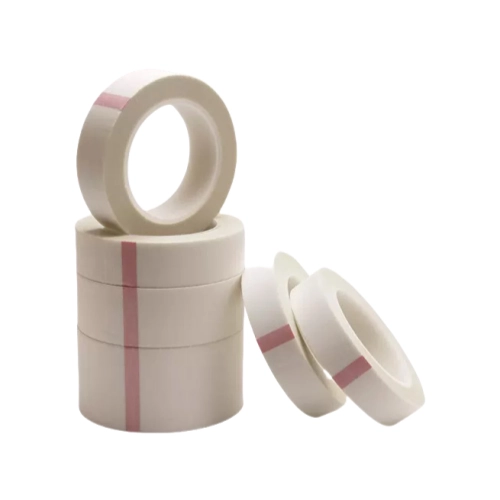
Glass cloth tape uses a woven fiberglass backing to add mechanical reinforcement where ordinary film tapes may stretch, tear, or abrade too easily. The backing contributes dimensional stability and edge strength, while the adhesive system controls bonding, heat ageing, solvent or varnish interaction, and removal behavior. Within the glass cloth tape family, reinforcement should be evaluated separately from purely electrical-insulation selection and from temporary high-temperature masking.

Why Woven Fiberglass Provides Mechanical Reinforcement
The reinforcement comes from the woven backing rather than from a generic claim that the tape is simply “strong.” The yarn structure helps limit stretch and improves resistance to tearing and abrasion during tight wrapping, banding, anchoring, and handling. This is useful when a taped assembly must keep its shape under winding tension, vibration, edge contact, or repeated handling.
Heat, Abrasion, and Edge Stress: What the Backing Actually Does
Woven fiberglass can remain dimensionally stable when a wrap is exposed to heat, friction, sharp component edges, or repeated handling. The adhesive is a separate part of the construction: silicone, acrylic, and thermosetting rubber systems can have different bonding, heat-ageing, solvent, impregnation, and removal behavior. Temperature limits, flame performance, and chemical resistance must therefore come from the exact tape grade and its verified data.
Where High-Temperature Reinforcement Is Most Useful
The most relevant industrial uses are those that need both a woven reinforcement layer and an adhesive bond: coil outer wrapping, lead anchoring, transformer banding support, selected high-temperature wire or harness protection, and process locations where the backing must resist tearing or abrasion. If electrical insulation is the primary purchasing task, dielectric qualification and the approved insulation system should take priority over a broad reinforcement claim.

Backing and Adhesive Must Be Evaluated Together
Two glass cloth tapes can share a woven fiberglass backing but behave differently because of adhesive chemistry, backing weight, thickness, finish, liner, or converting format. Silicone, acrylic, and thermosetting rubber systems should be compared by the actual heat history, surface, dwell, varnish or resin exposure, removal requirement, and winding process rather than by a single material name.
Heat Resistance Depends on the Complete Construction
Fiberglass itself is heat resistant, but the usable tape temperature is controlled by the full construction, especially the adhesive and the duration of exposure. Continuous service, short process peaks, heat ageing, clean removal, and post-heat adhesion are different requirements. Use only the temperature data verified for the actual supplied grade and test condition.
Thickness and Build-Up Are Selection Variables
A thicker tape is not automatically a better high-temperature tape. Thickness changes wrap build-up, flexibility around small radii, edge step, impregnation behavior, and the number of layers needed for the assembly. Select thickness together with the backing, adhesive, overlap, component geometry, and required electrical or mechanical function.
Common Failure Modes to Check Before Approval
A reinforced backing does not remove application risk. Common problems include edge fraying during slitting or wrapping, lifting on contaminated surfaces, adhesive transfer after heat exposure, uneven overlap, excessive build-up, poor contact around bends, and incompatibility with varnish, resin, solvent, or a downstream process. A representative sample should be checked on the actual component with the intended wrap tension, overlap, heat cycle, and removal or impregnation requirement.

In Conclusion
Glass cloth tape is most useful as a high-temperature reinforcement when the woven backing, adhesive system, wrap geometry, and exposure cycle are selected together. Confirm the supplied grade against the actual substrate, heat history, mechanical stress, varnish or resin contact, and required test data instead of treating every fiberglass-backed tape as interchangeable.