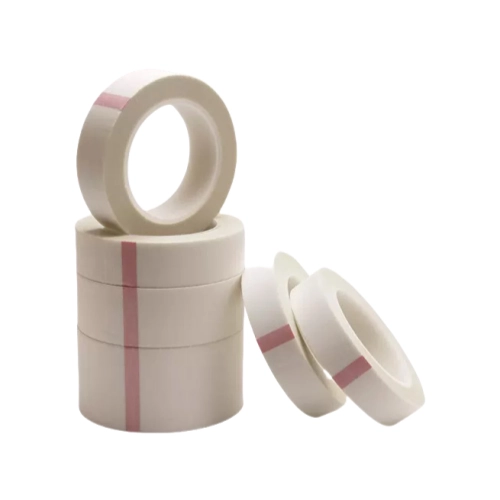
Glass cloth electrical tape is used where electrical insulation needs a woven backing that can also resist tearing, abrasion, and dimensional movement during wrapping. Typical applications include motor leads, coil outer wraps, transformer layer and crossover insulation, lead-pad hold-down, and reinforced cable sections. The temperature and dielectric limits depend on the exact backing, adhesive, thickness, and qualification data, so the supplied grade should be verified rather than treated as a generic “high-temperature tape.” For category-level selection, use the glass cloth tape family.
Fiberglass Tape for Electrical Insulation
The woven fiberglass backing gives the tape mechanical reinforcement around electrical components that may see vibration, edge stress, or repeated handling. In motors, it can be used around lead wires, end turns, and selected winding sections. In transformers, common roles include outer wrapping, layer and crossover insulation, coil banding support, and lead anchoring. Product-level dielectric, thermal-ageing, thickness, flame-performance, and adhesive data must come from the actual grade rather than from the material name alone.

How Temperature and Adhesive Choice Affect Electrical Use
Heat performance belongs to the complete tape construction, not to the fiberglass backing alone. Silicone adhesive systems are widely used in elevated-temperature electrical applications, while acrylic and thermosetting rubber systems can be selected for different bonding, converting, ageing, varnish, or processing requirements. A competitor’s temperature rating should never be transferred to another construction; use only the approved TDS and test method for the supplied grade.

How Silicone-Adhesive Glass Cloth Tape Is Evaluated
Silicone adhesive is commonly considered when the electrical assembly sees elevated temperature, but selection still depends on the substrate, winding pressure, dwell, heat ageing, varnish or resin contact, and the required dielectric or flame-performance documentation. Conformability and bond retention should be checked on the actual coil, lead, or cable geometry rather than assumed from adhesive chemistry alone.
Silicone Glass Cloth Electrical Tapes
In addition to its high heat tolerance, silicone glass cloth tape is also great for outdoor use. It can handle all sorts of weather without losing its effectiveness. This makes it a top choice for protecting wires and equipment in all kinds of environments.

Why Color Is a Secondary Electrical Selection Factor
White is common for glass cloth tape, but color should not be treated as the primary electrical performance difference. For insulation work, backing construction, adhesive system, thickness, dielectric data, thermal ageing, slit-edge quality, and compatibility with the winding or impregnation process are more important. Color may support inspection or identification only when that requirement is part of the approved specification.

Typical Electrical Use Cases
– Motor leads and end turns where the wrap needs electrical insulation plus mechanical reinforcement.
– Transformer outer wrapping, layer insulation, crossover insulation, and lead hold-down.
– Coil banding or reinforced wrapping where low stretch and edge strength are important.
– Cable and harness sections exposed to abrasion or elevated temperature, subject to the approved construction.
– Electrical process areas where the exact tape grade has been qualified for the substrate, exposure cycle, and required test method.
When mechanical reinforcement rather than electrical insulation becomes the main purchasing question, that requirement should be evaluated separately so this article stays focused on electrical use.
In Summary of Glass Cloth Electrical Tapes
Glass cloth electrical tape is most useful when electrical insulation, mechanical reinforcement, and heat exposure must be considered together. Select the exact grade from verified adhesive, thickness, dielectric, thermal-ageing, flame-performance, and application data, then test it in the real wrap geometry and process before repeat production.