

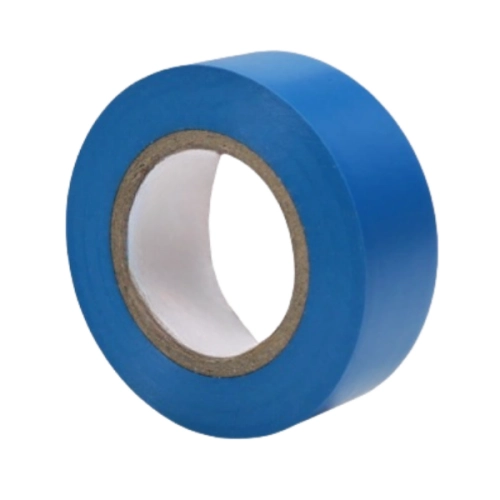


Foshan Opalus Adhesive Products Co., Ltd. is a PVC insulation tape manufacturer serving importers, wholesalers, tape converters, industrial supply brands, and electrical procurement teams. Our range includes glossy jumbo rolls, blister-card packs, heat-resistant grades, CE-documentation-support grades, UL Listed grades, and lead-free grades. Different PVC constructions, roll formats, customization options, equipment requirements, and supporting documents can be compared before a grade is matched to the intended application, market, or converting program.

PVC Insulation Tape Product Range
The six PVC tape directions are separated by how the material will be specified, converted, documented, or presented rather than by color alone.
Glossy PVC Electrical Tape Jumbo Roll fits programs where slitting, rewinding, or local packing comes next. In this case, roll width is only part of the specification; core ID, target slit width, thickness tolerance, roll geometry, and unwind behavior can have just as much influence on downstream conversion.
Blister Card PVC Electrical Tape suits channel-ready product programs, while Heat-Resistant PVC Electrical Tape is intended for applications where operating temperature needs to be matched to a dedicated grade.
Documentation-led requirements follow a different path. PVC Electrical Tape with CE Documentation Support, UL Listed PVC Electrical Tape, and Lead-Free PVC Electrical Tape address target-market documentation, Listed-product requirements, and restricted-substance control respectively. They should not be presented as interchangeable certifications, and temperature, voltage, or compliance claims remain specific to the selected model.
Benefits for Different PVC Tape Programs
- Six PVC product directions can be compared without pulling glass cloth, polyimide, wire-harness, or other adjacent tape categories into the same decision.
- A consistent electrical insulation tape specification makes supplier quotations and samples easier to compare on the same basis.
- Jumbo, slit, finished, and retail-ready formats can be matched to the actual converting or distribution workflow.
- Backing thickness and total tape thickness are treated as separate construction fields instead of one vague “thickness” value.
- Core, surface, color, label, and finished-roll format can be fixed before a sample becomes the production reference.
- Repeat programs can use the same approved specification rather than relying on visual similarity between batches.

What Should Be Confirmed Before Comparing PVC Insulation Tape Grades?
Two PVC tapes may appear nearly identical in a quotation and still behave differently when they are slit, rewound, wrapped, or stored. The first comparison should therefore be the construction itself: PVC film backing, adhesive system, backing thickness, total tape thickness, width, length, surface, color, paper core, and supply form.
The less obvious differences often show up later. Thickness tolerance may affect conversion; elongation and peel adhesion influence handling; unwind behavior matters on a slitting or rewinding line. Technical figures also need context. A peel or tensile value obtained under a different test method or conditioning procedure should not automatically be treated as equivalent to another supplier’s result.
The same caution applies when two quotations both state 0.15 mm. Unless both are measuring the same part of the construction, the figures may not describe the same tape.

Technical Range / Category TDS
| Item | Typical Range / Customizable Value |
|---|---|
| Backing material | Flexible PVC film backing; formulation varies by grade |
| Adhesive system | Pressure-sensitive adhesive; rubber-based systems available by grade |
| Backing thickness | Confirm separately from total thickness; grade-specific |
| Total tape thickness | Common category reference: 0.10-0.20 mm; actual range depends on the selected grade |
| Thickness tolerance | Project-specific; define the measurement basis and acceptable tolerance before sample approval |
| Finished width | Common finished-roll reference: 12-50 mm; other slit widths available by project |
| Roll length | Common finished-roll reference: 5-33 m; confirm by grade and roll format |
| Color | Standard colors plus custom colors |
| Surface | Glossy or matte, depending on grade |
| Supply form | Jumbo roll, slit roll, finished roll, blister-card pack |
| Core size | Match finished-roll format or converting equipment |
| Peel adhesion to steel | Grade-dependent; compare values obtained under the same stated test method |
| Tensile strength | Grade-dependent; review the method, specimen condition, and available conditioning information |
| Elongation at break | Grade-dependent; review with conformability requirements |
| Unwind behavior | Grade-dependent; important for slitting and rewinding |
| Temperature requirement | Model-specific; separate application and service temperature |
| Electrical requirement | Voltage and dielectric requirements are model-specific |
| Test / compliance documents | Confirm by model, target market, and requested standard |
| Storage / shelf life | Grade-specific; review original packaging, storage environment, sunlight exposure, and inventory time |
| OEM / private label | Roll size, color, surface, core, artwork, label, and presentation |
| Batch reference | Approved sample and specification recommended for lot-to-lot comparison |
ASTM D1000 treats thickness, tensile strength, elongation, adhesion, dielectric performance, flagging, unwind force, puncture resistance, aging, width, and roll length as separate test properties. That is useful when comparing PVC tapes because nominal thickness alone cannot establish how a grade will behave mechanically, electrically, or during conversion.
Published data from one four-grade PVC electrical tape series show the relationship clearly. Under the stated ASTM D1000 method, total thickness increased from 0.11 to 0.17 mm, while tensile strength ranged from 18 to 24 N/cm and elongation from 140% to 170%. Over the same four grades, 180-degree peel adhesion was reported from 1.9 to 1.6 N/cm. The figures are external grade-specific reference data, not specifications of Foshan Opalus Adhesive Products Co., Ltd. Complete conditioning details were not published, so the selected grade’s confirmed TDS and agreed test conditions should remain the basis for production approval.

PVC Film Thickness vs Total Tape Thickness
PVC film thickness describes the backing, while total tape thickness includes the adhesive layer. A quotation stating 0.15 mm is incomplete unless the measurement basis is clear. Two tapes can share the same total thickness yet differ in backing-to-adhesive proportions, so other properties should be reviewed separately.
PVC Supply Formats and Converting Compatibility
What happens after production determines the most practical supply form. Jumbo rolls make sense when slitting, rewinding, labeling, or packing will be completed locally. Slit rolls are more appropriate when width has already been fixed but further conversion remains. Finished rolls arrive with the agreed width, length, core, and roll geometry, while blister-card formats are prepared around a channel-ready SKU.
For tape converters, the paper core should be treated as part of the machine interface rather than a cosmetic customization. Core ID, target slit width, thickness tolerance, unwind stability, and finished-roll geometry all affect how the material runs. A roll can meet its nominal dimensions and still create scrap if edge condition is poor, telescoping develops, alignment is unstable, or unwind behavior does not suit the line.
Private-label work also becomes easier to control when the complete SKU is agreed at the start. Grade, thickness basis, size, color, surface, core, artwork, label, and presentation should be treated as one specification rather than separate last-minute requests.
Applications
- Electrical wire and cable insulation where the selected PVC grade matches the specification.
- Cable joint wrapping and protective overwrap in industrial electrical work.
- Wire identification and color coding using specified PVC colors.
- Electrical maintenance, equipment assembly, and general industrial wiring.
- Jumbo-roll conversion into smaller finished-roll formats.
- Distributor and private-label programs using finished PVC tape.
When a cable joint may require either pressure-sensitive PVC wrapping or a self-fusing elastomeric layer, compare self amalgamating tape vs electrical tape before selecting the tape construction.
Procurement Checks Before Sample Approval
A visually acceptable sample is not enough for a repeat PVC tape program. The reference should also record the application, thickness definition, dimensional tolerance, size, color, finish, application temperature, service temperature, target market, required documents, core, packaging, and expected volume.
Application temperature and service temperature deserve separate fields. The first influences unwind, initial adhesion, and conformability while the tape is being applied. The second concerns the environment the tape sees after installation.
Storage can change what later arrives at the converting line or job site. Heat, humidity, sunlight exposure, damaged original wrapping, or extended inventory time may affect adhesive condition or roll geometry. Keeping the approved sample together with the specification revision, agreed test method, and finished-roll definition gives both sides a clearer basis for reviewing lot-to-lot consistency.
How Should PVC Electrical Tape Thickness Be Selected?
Choosing PVC electrical tape thickness is less about selecting the largest available number and more about balancing conformability, physical build, and mechanical protection. A flexible construction can follow bends and irregular geometry more closely, while a heavier construction may provide additional build where abrasion or puncture exposure is relevant.
Thickness still needs to be separated from electrical rating, dielectric performance, temperature capability, and certification status. Published grade data show that tensile strength, elongation, and peel adhesion can change alongside thickness rather than simply increasing together.
Application behavior is another useful check. If a trial shows flagging or edge lifting, increasing thickness alone may not address the cause. Adhesive grade, surface cleanliness, application temperature, overlap, wrapping geometry, applied tension, and the overall tape construction should be reviewed together.

FAQ
What test information should be compared between PVC tape samples?
Compare results obtained under the same or clearly identified test method. Thickness, peel adhesion, tensile strength, elongation, and electrical properties should include enough method and conditioning information to make the values comparable.
How do I confirm a jumbo roll will match our slitting equipment?
Provide core ID, slit widths, roll dimensions, and machine limits before sampling. Trial conversion is useful for a new roll geometry or construction.
What documentation should be confirmed for a controlled PVC tape grade?
State the target market, required standard, certification status, restricted-substance requirement, or supporting document before selecting the grade. Documentation should be confirmed for the specific model.
Can MOQ change when the PVC tape specification is customized?
Yes. MOQ can vary with grade, color, dimensions, core, printed components, or blister-card and private-label requirements. Share the complete SKU and expected volume.