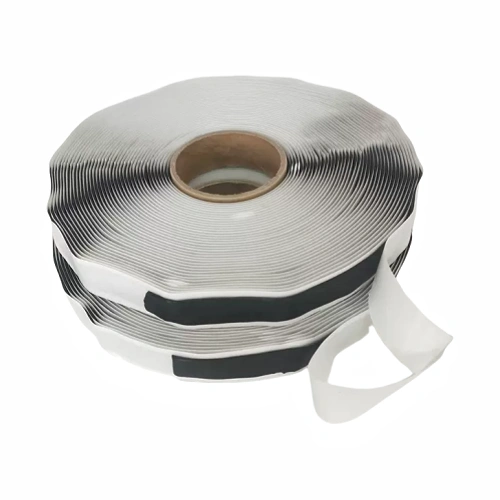
Common uses for butyl tape include sealing metal roof laps, HVAC duct joints, window perimeters and selected vehicle or equipment-panel seams against water, air or dust. A continuous sealing line must contact the actual mating surfaces; a concealed, clamped strip and an exposed foil-faced repair serve different joint designs. Check the gap, surface finish and temperature before treating either construction as suitable.
Roof laps, duct flanges and windows: locating the leak path
Find interruptions before measuring tape width
When evaluating butyl tape for metal roof laps, place the sealing layer between overlapping sheets as specified by the roof-system design; confirm the side or end lap, fastener pattern and required compression. An exposed surface patch performs a different job: it covers an existing seam but must also keep its own edges attached. Neither approach repairs a damaged roof assembly by itself. For the preparation and placement sequence used in roof-panel laps, see how to install butyl sealant tape on metal roofs.
For HVAC duct joints, a specified strip may sit between mating flanges, while a foil-faced construction can cover a compatible duct seam or repair insulation facing, subject to the duct-system specification. At window frames, a qualified preformed butyl seal can be part of the assembly, but it cannot replace structural glazing components. Selected vehicle-trim and equipment-panel interfaces use similar materials for non-structural water or dust sealing.
Assembly and possible use | Leakage path to examine | First check before selecting tape |
Metal roof or wall-panel lap | Water travels along an overlap or fastener line | Lap geometry, clamping and approved roof detail |
HVAC duct flange or seam | Air escapes at flange corners or sheet-metal edges | Joint shape, pressure class and applicable duct specification |
Window or door perimeter | Water enters behind a frame or through a corner | Drainage path, frame material and system detail |
Vehicle trim or equipment cover | Splash water or dust passes through a panel interface | Fastener spacing, vibration and future disassembly |
Insulation-facing repair | Vapor or air passes through a damaged facing | Facing compatibility and uninterrupted edge contact |

A simple drawing helps here: draw the route from the wet or pressurized side to the protected side, then place the intended seal across that route. Mark every interruption, including a corner, fastener, splice and change in substrate. This makes it easier for engineering and purchasing teams to discuss the same failure path instead of comparing product names in isolation.
These applications need grade-specific confirmation. For concealed interfaces, the
butyl sealant tape family distinguishes double-sided strips from more conformable mastic constructions; the correct choice still depends on the joint.
Exposed patch or concealed strip? The facing changes the job
A facing protects the surface; it does not fix the joint underneath
A hidden butyl strip and an exposed butyl repair tape should not be treated as interchangeable. Inside a clamped lap, the mating parts protect the sealant and help maintain contact. On an exposed roof or duct surface, a protective backing, edge adhesion and weathering performance become part of the design. Aluminum foil is one possible facing, but a foil layer alone does not establish that the complete tape is suitable for long-term sunlight, ponding water or high temperatures.
Review the exact product data, expected exposure and substrate compatibility. If the assembly needs an exposed flashing detail, follow that system’s specified material and installation method rather than substituting an unfaced joint strip. For building junctions requiring a water-shedding overlap, butyl aluminium flashing tape illustrates a flashing-specific construction whose substrate, edge termination, and exposure conditions should be checked.
For a concrete HVAC example, the site’s butyl mastic foil tape page describes an aluminum-foil/butyl-mastic/release-liner construction and lists 50, 75, 100 and 150 mm widths. Those are product-specific options, not minimum widths for every project; confirm the current grade, dimensional tolerances and assembly requirements.
When assessing foil-faced butyl tape for exposed seams, check whether the foil wrinkles over corrugations and whether the outer edge remains fully bonded after a representative installation cycle. A foil facing may protect the adhesive underneath, but a lifted perimeter can still admit water behind the patch. If the roof detail uses a mechanical fixing or a specified primer, include those requirements in the trial. For accessible, non-structural container or trailer panel maintenance, the aluminum backed butyl repair tape product page covers a different use case from roof flashing or concealed compression joints.
At a roof seam with changes in profile, prepare a small trial across a rib, a fastener-adjacent area and a straight span rather than judging only a flat coupon. Photograph the same locations before and after the specified installation cycle, and document where the backing bridges a recess or sealant is displaced. These observations help separate a placement problem from an unsuitable facing or joint detail; they are not evidence of long-term weather resistance.

To compare faced constructions, consult the
aluminium butyl tape range rather than treating it as the same family as concealed joint sealants.
Exposed roofing flashings are a separate system decision. Some flashing products are bituminous rather than butyl-based. Check the adhesive chemistry, backing, approved substrates and roof manufacturer’s requirements instead of assuming that every self-adhesive flashing roll is butyl tape.
The joint-gap trial: what remains after the parts are clamped
Inspect the compressed cross-section, not only the roll
Make a trial joint using production-representative sheet metal, coating and fasteners. Before closure, mark the intended sealing line and note corners, intersections and screw positions. After fastening to the specified assembly condition, inspect whether the seal runs continuously through those changes in geometry.
Look for local squeeze-out, an unfilled recess, misalignment, folded tape and loss of usable contact width after placement variation. If a release liner tears during automated placement, the strip may stretch or wander; check liner release and roll presentation as part of the trial, not only material adhesion.
For a repeatable joint-fit check, record the unloaded gap at several locations, then inspect the closed assembly at the same points. Keep fastener type, tightening sequence and mating-part finish consistent between samples. Where destructive sectioning is permitted, inspect a cut-through at a corner and splice to reveal channels hidden from the outer surface. Agree on the minimum acceptable continuous contact before testing; do not invent a universal compression percentage for different butyl formulations.

A product-specific illustration of manufacturing tolerances comes from Tremco’s 440 Tape data sheet: width tolerance is ±0.8 mm and thickness tolerance is +0.4/-0 mm. Those figures belong to Tremco 440, not to all butyl products or to OPALUS. A production drawing should state its own agreed tolerances and the resulting permissible joint gap.
Coated substrates and cold installation can change the outcome
Read temperatures together with their source and restrictions
Substrate compatibility cannot be inferred from substrate names alone. Bare aluminum, painted steel, powder-coated metal, glass and plastic can present different surface energies, textures and contamination risks. Use the actual finish and production cleaning process in sample trials. Surface preparation should start with surfaces free from loose particles, oil, standing water and frost unless a specific grade has validated instructions for another condition.
Butyl tape application temperature and service temperature answer separate questions: when a grade can be installed and what the finished joint may experience in service. Confirm both from the current data sheet. Do not infer cold-installation capability from a low service-temperature rating or treat a short heat-aging result as a continuous operating limit.
Tremco’s published 440 Tape technical data sheet lists an application range of -7 to 49°C and a service range of -40 to 70°C for that specific grade. Its product webpage displays a different, wider service range of -54 to 93°C. Because those published sources disagree, a project relying on the temperature limit should obtain the current approved data sheet and written application guidance; neither range should be copied into another brand’s specifications.
Check a trial on the most difficult actual surface, such as a low-energy plastic, a textured powder coating or a substrate carrying a process release agent. If the assembly will be cleaned with detergents, exposed to oils or placed next to another sealant, conduct compatibility testing with the substances and materials that will actually contact the butyl.
When comparing butyl tape adhesion on painted metal or other test specimens, record whether the coating is new, fully conditioned or weathered and whether cleaning matches the approved production process. A favorable result on clean laboratory steel should not be transferred automatically to a painted enclosure or a plastic component.
Wet-surface installation deserves its own qualification. Moisture can block adhesive contact and can become trapped beneath a sealing layer. The site’s
wet-surface application guide discusses this separate issue; do not generalize its repair suggestions into permission to install any butyl grade onto a wet substrate.
A strong peel result is not a leak-test result
Separate laboratory values from assembly acceptance
ASTM D3330/D3330M describes peel-adhesion methods for pressure-sensitive tapes, including a 180° method for selected single-coated tapes and a 90° method for selected single-coated tapes. Choose the method that fits the actual construction; highly deformable butyl may require an agreed adaptation and careful interpretation. Report a value such as N/25 mm only when the specimen width and method support it.
ASTM D3654/D3654M addresses shear adhesion under a constant load parallel to a bonded surface. It is not a universal butyl-sealant qualification and does not substitute for a project-specific creep or squeeze-out assessment. An agreed trial can supplement those material tests by observing a clamped joint after its specified thermal or mechanical conditioning.
For interpretation of published reference values and test families, review the butyl tape technical data sheet. Confirm the exact grade, method and conditions before adopting any figure as a project acceptance criterion.

Verification stage | What to record | What it cannot establish on its own |
Peel adhesion | Test method, angle, substrate, width, dwell and force | Watertightness of a full joint |
Shear or creep observation | Load, bonded area, temperature, time and displacement | Resistance to air leakage at corners |
Trial assembly | Gap, clamping, location, squeeze-out and continuity | Long-term field service life |
System leakage test | Applicable system method, pressure, duration and leakage result | A transferable rating for every tape grade |
For specified window and curtain-wall assemblies, ASTM E331 addresses water penetration under uniform static air-pressure differences; ASTM E283/E283M addresses air leakage of defined fenestration assemblies. These are assembly-level references, not certificates for a roll of tape. An HVAC duct leakage test requires the applicable duct-system method and acceptance criteria.
Prepare a test record linking each specimen to its tape batch, actual substrate finish, joint drawing revision and installation date. Define the leakage acceptance criterion from the applicable assembly specification before testing, and note both measured outcomes and visible failure locations. If a specimen fails, change one variable at a time, such as cleaning method or seal position, and repeat the same test. A pass on one prototype supports that defined configuration; it does not automatically approve alternative coatings, joint gaps or production batches.
Use an approved sample as a repeatable reference
To check batch consistency before routine production, retain the approved sample and written specification, including grade, structure, nominal dimensions, tolerances, liner, application conditions and agreed acceptance criteria. Confirm whether later test reports use the same substrate and method. A different peel angle or dwell period can make a superficially similar number unsuitable for direct comparison.
Reading failure patterns before changing the sealant
Corner leaks and edge lift point to different causes
Hold an assembly for investigation when identical parts show inconsistent bonding or leakage. Before changing sealant chemistry, isolate process variables such as coating batches, cleaning, tape placement, fastener clamping and available contact width. Record whether defects cluster by substrate lot or joint geometry.
Avoid fixing an unexplained leak simply by stacking additional layers; that can alter fit-up without closing the original channel. If the assembly relies on the tape for structural strength, fire performance, electrical insulation, continuous immersion or a regulated safety function, use a material and system explicitly qualified for that duty rather than assuming that general-purpose butyl is acceptable.
An intermittent leak near a corner suggests a discontinuous sealing route; leakage across a long straight run may indicate inadequate contact or misplaced tape. To investigate butyl tape edge lift on an exposed patch, assess perimeter contact and exposure separately from a concealed strip extruding under pressure. Record where the defect begins and reproduce the joint geometry before changing adhesive grade.
If removal is part of maintenance, establish an acceptable residue and surface-finish criterion on actual coated or painted parts. Butyl may leave adhesive behind or affect sensitive finishes; no-residue or damage-free removal should never be promised without application-specific evidence.
For non-standard sizes or liner formats, confirm the manufacturer’s
coating and converting capabilities against the trial requirements before signing off the production specification.
Document the corrected seal route, the associated process change and the repeat verification result before production resumes. This distinguishes a validated joint correction from a one-off repair.
Frequently Asked Questions
Is butyl tape suitable for every roof leak?
No. A compatible butyl product may help seal a specified roof lap or approved repair detail, but damaged roofing, poor drainage, unsupported gaps and incompatible membranes require a system-level assessment. Confirm the roof manufacturer’s instructions and test the proposed detail where necessary.
Can butyl tape replace a structural adhesive or glazing component?
Not by default. Most uses discussed here involve non-structural sealing. Structural glazing, load-bearing bonding and safety-critical assemblies require materials and designs qualified for those functions. A high peel value does not establish structural capacity.
Does a higher peel-adhesion number mean a better waterproof seal?
Not necessarily. Peel force changes with the test method, substrate, dwell and tape construction. Water can still pass through a gap, corner or termination even if a specimen bonds strongly to flat steel. Evaluate the full assembled joint against its leakage requirement.
What should be supplied with a sample for production approval?
Provide the real substrate and finish, joint drawing, minimum and maximum gap, clamping method, temperature and exposure conditions, selected tape construction and liner requirements. Agree on material tests, assembly leakage checks, tolerances and the failure observations to record before approving repeat production.